
Nigerian dual citizenship and US naturalisation

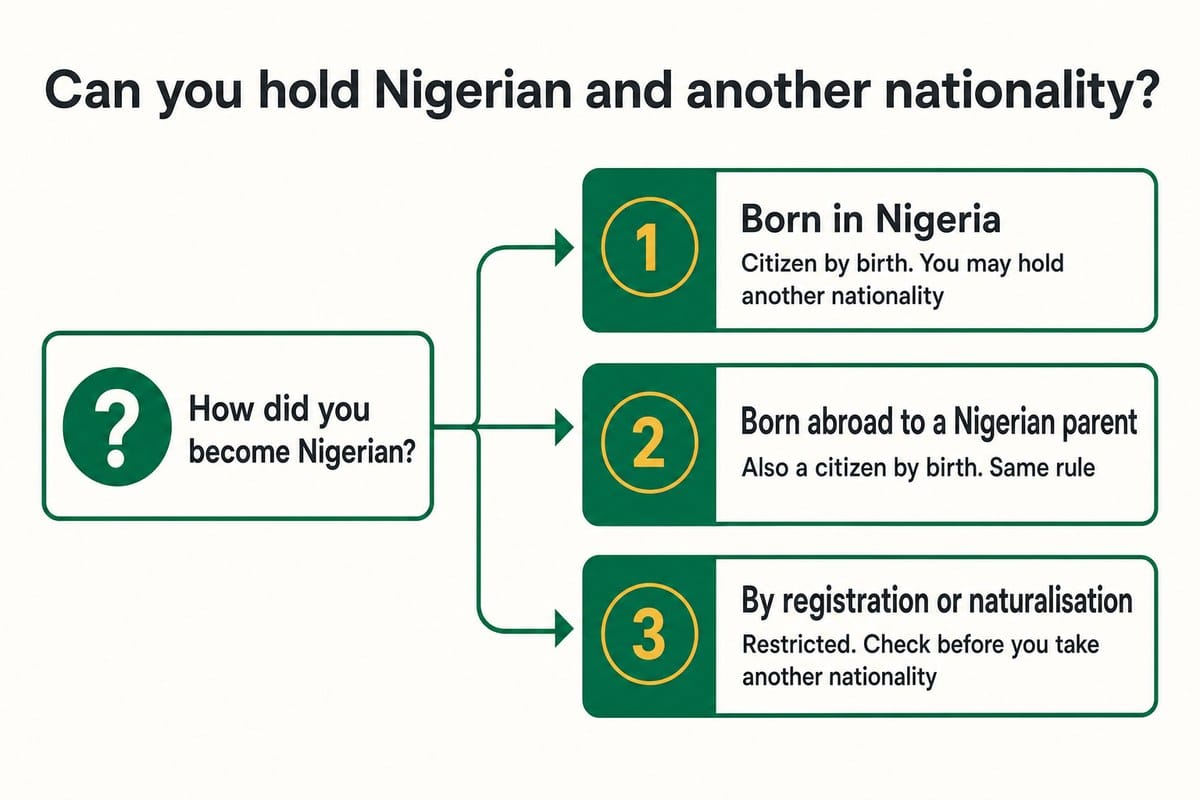
Nigeria allows dual citizenship, and the rule that matters is who it allows it for. The 1999 Constitution draws a line between citizenship by birth and citizenship acquired by registration or naturalisation, and the two are treated differently.
A Nigerian citizen by birth keeps that citizenship on taking another nationality. Someone who became Nigerian by registration or naturalisation does not have the same protection.
A child born in the United States to a Nigerian parent is Nigerian by birth already. That child does not acquire citizenship later; the paperwork records something that is already true.What the distinction changes in practice
| Route to Nigerian citizenship | May hold another nationality |
|---|---|
| By birth, born in Nigeria | Yes |
| By birth, born abroad to a Nigerian parent | Yes |
| By registration, usually through marriage | Restricted |
| By naturalisation | Restricted |
This is the question to settle before a United States naturalisation ceremony rather than after it, because the order of events can matter and the ceremony is not reversible.
What the consulate can and cannot do
- Confirm which route made you Nigerian: by birth or by registration
- Renew the Nigerian passport before the ceremony if it is close to expiry
- Register the children’s births with the consulate while the documents are current
Nigeria's entry rules expect a Nigerian citizen to arrive on a Nigerian passport, so a dual national who lets the Nigerian booklet lapse has created a problem for the next trip rather than avoided one.
Where the confusion comes from
Two things get mixed up in almost every conversation on this subject. One is whether Nigeria permits dual citizenship, which it does for citizens by birth. The other is whether the United States permits it, which is a separate question with a separate answer and no Nigerian official can speak to it.
The American naturalisation oath contains renunciation language, and that language has caused decades of anxiety among people who assumed it stripped them of their first nationality. What matters for Nigerian purposes is the Nigerian rule, and the Nigerian rule protects citizenship by birth.
What a dual national should carry
Nigeria expects a Nigerian citizen to enter on a Nigerian passport. A dual national who arrives on an American passport alone can find the visa question raised at the border, because the officer sees a foreign document and no Nigerian one.
The practical answer is to keep both current. That means renewing the Nigerian booklet on its own schedule, which is where the six-month advice on the passport page becomes relevant to people who rarely use it.
Passing citizenship to children
Citizenship by descent runs through either parent. A child born in America to one Nigerian parent is Nigerian by birth, and the documentation that records it is an attestation of citizenship plus the birth registration.
The window worth watching is the parent's own passport. The attestation rests on the Nigerian parent's documents, so a lapsed booklet turns a simple registration into an evidential exercise. Doing the child's paperwork while the parent's passport is current avoids that entirely.