
Age declaration: fixing a date of birth

A declaration of age is the document you need when your date of birth was never registered, or was registered wrongly, and something official now depends on it. The consulate in Atlanta publishes both the requirements and the fee.
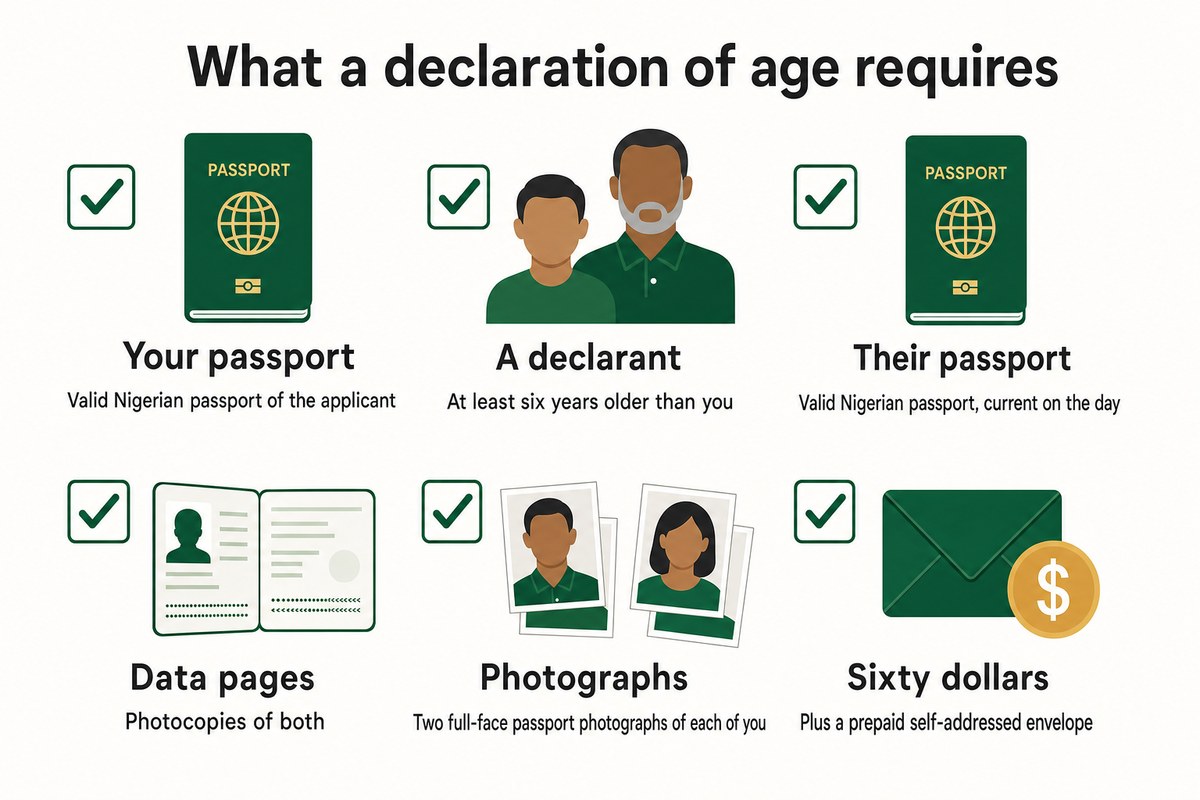
It costs $60, and it needs a declarant who holds a valid Nigerian passport and is at least six years older than you.What to bring
- Valid Nigerian passport of the applicant
- Valid Nigerian passport of the declarant
- Photocopy of the data page of both passports
- Two full-face passport photographs of each of you
- The $60 fee
- Prepaid self-addressed envelope
The six-year rule is the part people miss. A sibling close to you in age cannot act as declarant, however well they know your history, because the point of the requirement is that the declarant was old enough to remember.
What it will not fix
Because the declarant has to hold a valid Nigerian passport, this is one of the few consular documents where someone else's paperwork can hold yours up. Check their expiry date before booking anything.
Where a declaration of age is actually used
The document turns up in situations where a date of birth has to be fixed and no birth record settles it. Pensions, school enrolment in Nigeria, inheritance matters and a passport application built on an incomplete record all raise the question.
It is a sworn statement rather than a discovery. The declarant states what they know about when you were born, and the weight of the document rests on their being old enough to know it, which is what the six-year rule is doing there.
Choosing a declarant
The requirement is narrow: a valid Nigerian passport and at least six years' seniority. In practice that usually means a parent, an aunt or uncle, or a much older sibling, and it rules out cousins and friends of the same generation.
The declarant's passport has to be current on the day the declaration is made, not on the day they agreed to help. That is worth checking early, because a renewal on their side becomes a delay on yours and the renewal process is not quick.
What happens after
The declaration records a date; it does not rewrite the documents that already carry a different one. Anything issued earlier keeps saying what it said, so expect to produce the declaration alongside those documents rather than instead of them.
Where a birth was never registered at all, the sequence starts one step earlier with an attestation of birth, and the declaration follows it.