
Repatriating remains to Nigeria

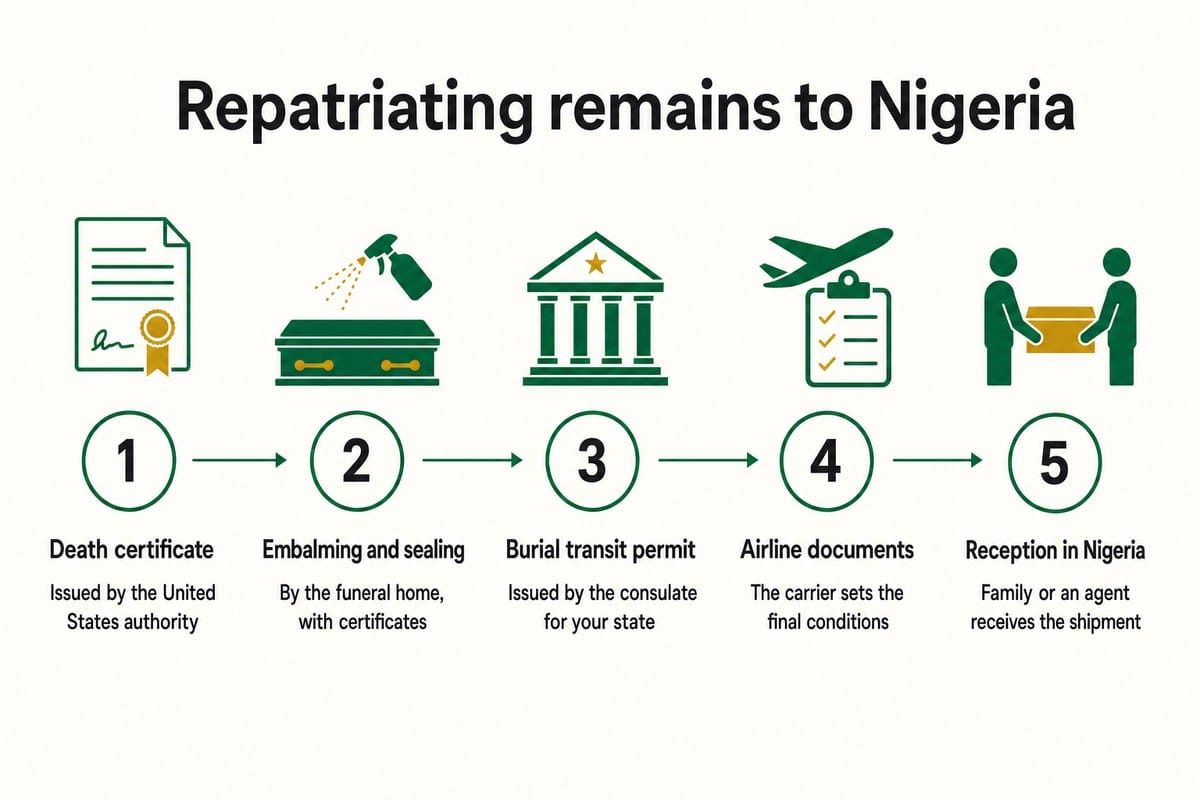
Repatriating a body to Nigeria involves a permit from the consulate, paperwork from the funeral home and conditions from the airline, and they have to happen in a particular order. Nobody reads this page at leisure, so the order is the first thing here.
The funeral director handles the American side. The consulate issues the burial transit permit. The airline sets the final conditions and can refuse a shipment that does not meet them.The order things happen in
| Step | Who | |
|---|---|---|
| 1 | Death certificate issued | US state authority |
| 2 | Embalming and sealing, with certificates | Funeral home |
| 3 | Burial transit permit | Nigerian consulate |
| 4 | Airline documentation and booking | Carrier |
| 5 | Reception in Nigeria | Family or agent |
The consulate in Atlanta publishes a requirements page specifically for shipping human remains to Nigeria, which is the only Nigerian mission in the country that sets it out in writing.
- Use a funeral director who has done an international repatriation before. It is a different process from a domestic funeral
- Confirm which consulate covers the state where the death occurred, not where the family lives
- Check the consular days before travelling: how each office works sets them out, and Atlanta opens its counter three days a week
Which office covers you is set out by state on this site, and the split does not follow the map: West Virginia is handled from Atlanta even though Washington is closer.
Why the order matters so much
Each step in this process produces a document the next step needs. The consulate cannot issue a permit without the embalming and sealing certificates, and the airline will not accept a shipment without the permit. Attempting them in parallel wastes the time it looks like it saves.
The one step that can start immediately is choosing a funeral director with international experience. They hold the relationship with the airline's cargo desk, and that relationship decides how smoothly the last two steps go.
Which consulate, and why it may not be the obvious one
The office is set by the state where the death occurred, not by where the family lives or where the burial will be.
Nigeria's three offices split the country by state, and the split does not follow the map. West Virginia is handled from Atlanta although Washington is closer, and Illinois from New York although nothing about that is geographically natural.
Atlanta handles counter work on Mondays, Tuesdays and Thursdays, which is the constraint that most often decides the timetable for a family in the South.
Costs nobody quotes upfront
The consular permit is one line on a bill that also includes embalming, a sealed casket built to airline specification, air freight charged by weight, and reception at the Nigerian end. The freight is usually the largest item and it varies by route and season.
The consular side of it is on the fees and requirements page, which is the only place this site publishes amounts, and only the ones Atlanta publishes.
Ask the funeral director for the whole figure rather than the consular one. Families frequently discover the difference between the two at the worst possible moment.
The deceased's own documents
The consulate will want to see identity documents for the person who died, and an expired Nigerian passport is normally enough for that purpose: nobody is renewing it.
Where no Nigerian document exists at all, a birth certificate or the family's own evidence of citizenship takes its place. Ask the consulate what it will accept before assembling a file that turns out to be the wrong one.